Specialty glass for metal-glass structures
The character of a metal-and-glass structure is determined by more than just the shape or color of the metal profile. Glass typically makes up the majority of the product’s surface area, so the choice of glass has a significant impact on light, privacy, and the overall interior aesthetics.
Piritas can use not only standard clear glass in metal-glass structures, but also a variety of non-standard options.
Do you want more privacy, a unique visual effect, or a different light transmission, but standard clear glass isn’t suitable for your project? We’ll help you select the right frosted, patterned, tinted, colored, laminated, decorative, or smart glass for your metal-and-glass structure based on the desired function and character of your interior. For questions regarding glass selection, structural solutions, or pricing, please contact us by phone at +370 698 31935 or by email at info@piritas.lt.
The main types of structures that incorporate glass are presented on the interior metal-glass partitions page.
Clear tempered glass
One of the most common solutions used in metal-and-glass partitions is clear tempered glass.
It is suitable when the main objectives are:
- to maintain light transmission;
- to avoid visually reducing the sense of space;
- to highlight the geometry of the metal frame;
- to create the impression of a lightweight interior wall.
Clear glass is often used in both residential and commercial interiors.
Frosted glass
Frosted glass is suitable where more privacy is desired, but one does not want to completely enclose the space with a solid wall.
It can be used in offices, bathrooms, or other rooms where visual separation is needed.
Patterned and decorative glass
Patterned glass can serve as a standalone interior design element.
Its varied textures alter the view through the glass, the way light passes through, and the character of the structure itself.
This solution can be used in both fixed partitions and doors.
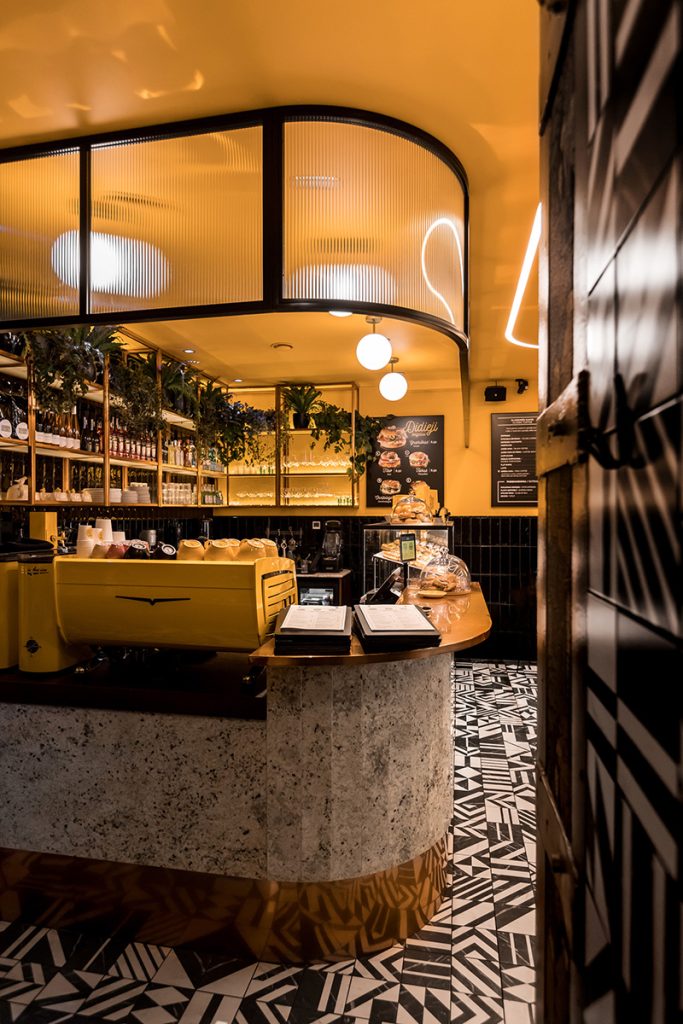
Fluted glass
One of Piritas’ publicly showcased projects is a structure made with curved “Flutes”-type glass for the “Holy Donut” café.
In this project, the wavy glass surface not only served as an interior accent but also diffused direct sunlight.
Flutes-type glass was also used in the door design for the “Super Are” restaurant in Sweden.
Tinted and colored glass
Glass doesn’t have to be just clear or frosted.
Depending on the project, the following types of glass can be used in structures:
- tinted glass;
- painted glass;
- other color solutions.
This variety allows the glass to be coordinated with the overall concept of interior materials and colors.
Wired glass
Wired glass has a visible internal mesh, so its visual character differs from that of completely clear glass.
It can be chosen for projects where the glass is not meant to be a neutral background but rather a visible design element.
Smart glass
Piritas can integrate smart glass.
A project featuring this solution is also presented in the company’s portfolio – “Smart Glass | Vilpra.”
Completed projects featuring specialty glass and other metal-glass solutions can be viewed on the projects page.
Glass units
Depending on the specific project requirements, glass units can also be integrated into the metal structure.
Their selection must be coordinated with the structure itself and its technical requirements.
Glass in doors
Specialty glass can be used not only in fixed walls.
It can also be integrated into swinging metal-glass doors, whose design is further coordinated with hinges, handles, locks, and other hardware.
Therefore, the choice of glass is part of the overall door design.
How is glass selected?
There is no single, universally best type of glass.
The selection is influenced by:
- the desired level of privacy;
- the amount of natural light in the room;
- the interior style;
- the purpose of the structure;
- the type of door or partition;
- the desired visual effect of the glass.
Piritas can integrate commercially available glass into metal-and-glass structures according to the specific needs of each project. Additional information on glass selection is available on the FAQ page.