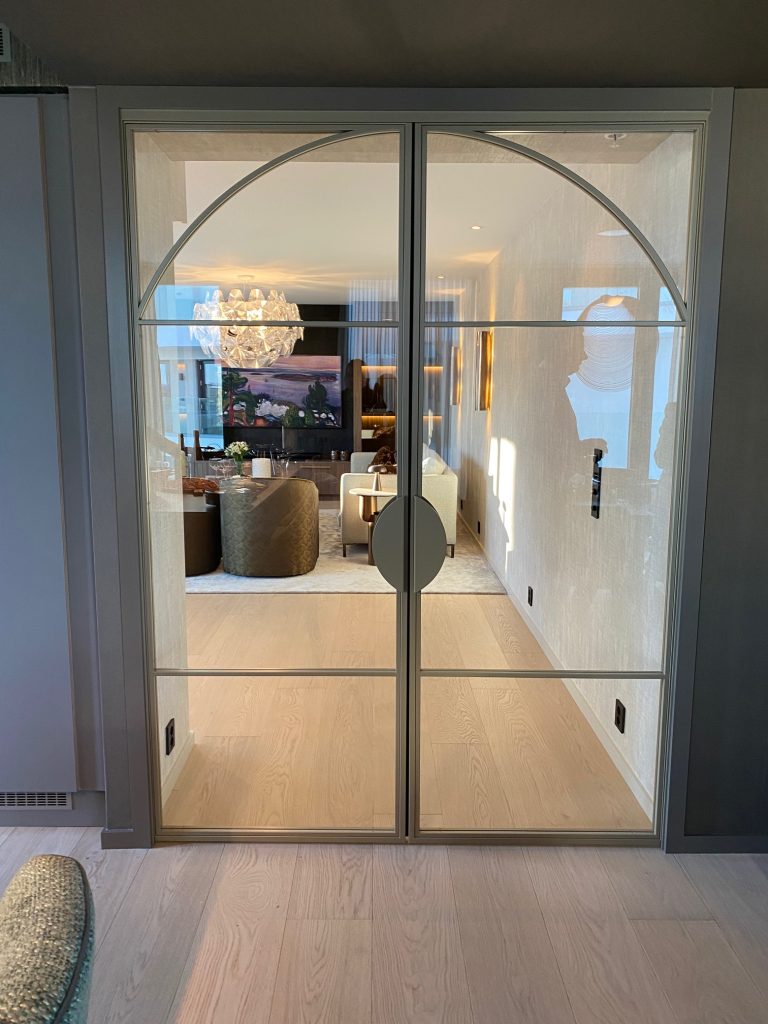
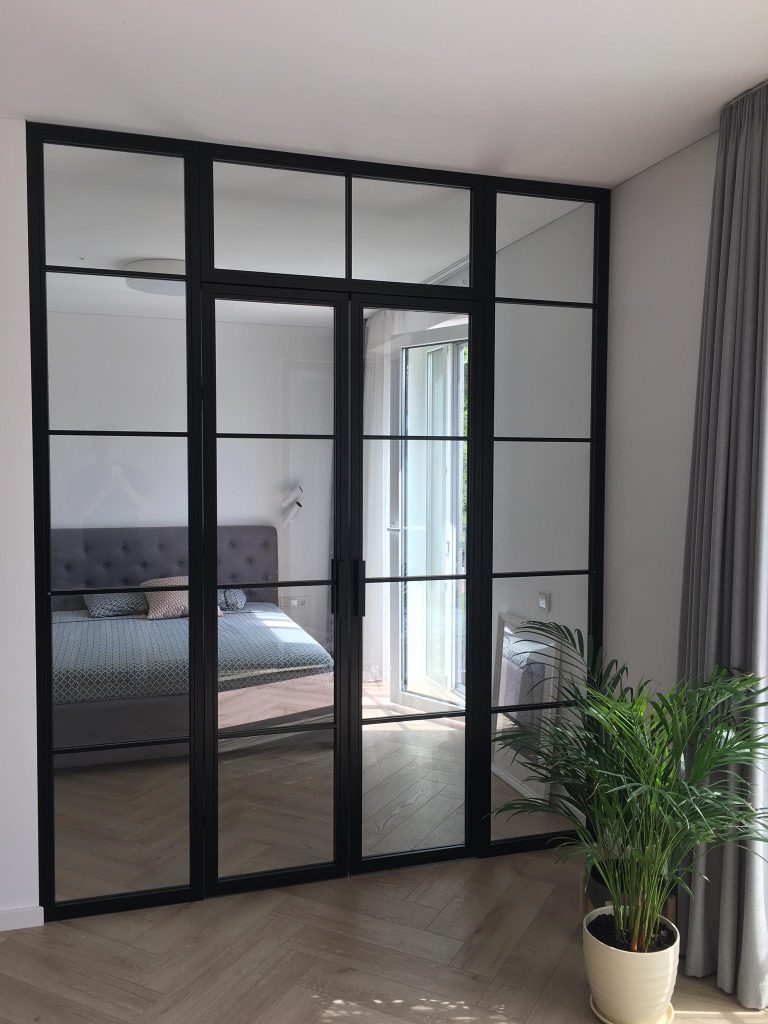
Metal-glass doors
Metal-and-glass doors allow you to physically separate rooms without losing the visual connection between spaces or natural light. Slim metal profiles combined with large glass panels give the structure a sense of lightness, making this solution suitable for both residential and commercial interiors.
Do you want to separate rooms while preserving natural light and visual connectivity between spaces? We’ll help you design and manufacture metal-and-glass doors tailored to your interior – from swing or pivot doors to custom designs with your choice of glass, hinges, and hardware. To discuss a solution, a project, or pricing, please contact us by phone at +370 698 31935 or by email at info@piritas.lt.
Piritas manufactures metal-glass doors to order. They can be standalone products or part of a larger partition.
You can read more about these types of structures on the page for swing-type metal-glass partitions.
Doors or parts of a solid partition
Metal-and-glass doors do not necessarily have to fit only a standard door opening.
Depending on the interior design, they can be combined with:
- fixed side panels;
- glass transoms;
- multi-panel metal-and-glass walls;
- double doors;
- a custom-divided metal frame.
In this way, the door structure can become part of the overall interior composition.
When a larger portion of the wall needs to remain non-opening, the doors can be integrated into a system of fixed metal-and-glass partitions.
Metal-glass door hinges
One of the most important customizable elements is the door hinges.
Exposed hinges
This is one of the most commonly used options. Exposed hinges allow for maintaining the clean aesthetics of the metal structure and using slim profiles.
Concealed hinges
The mechanism of concealed hinges is integrated into the structure. Therefore, when the door is closed, the focus remains on the geometry of the profiles and the glass.
Pivot-type hinges
The pivot mechanism provides a different principle of door operation. The door can swing in either direction, and when the hinge is mounted closer to the center of the door leaf, the structure can rotate around a selected axis.
Screw-in hinges
This type of hinge is also used in non-standard door or transom structures.
Door hardware and technical solutions
Metal-glass doors can be equipped with more than just hinges and handles.
Depending on the project, the following may be used:
- electromagnetic locks;
- automatic thresholds;
- door closers;
- soft-close mechanisms;
- various locking systems.
Handles are also selected on a case-by-case basis. The design may incorporate fixed pull handles or fold-down handles, and their design is coordinated with the overall style of the door and the interior.
When should you choose sliding doors?
A hinged door is not the most suitable solution for every space.
When it’s important to minimize the space occupied by the door, an alternative can be sliding metal-and-glass partitions. They can be designed with only a top track, and in certain projects, the doors can also be installed in a recess formed in the wall.
Therefore, the type of door should be chosen based not only on aesthetics but also on pedestrian traffic and available space.
Choosing the glass
The appearance of metal-and-glass doors is greatly influenced by the type of glass selected.
The following types of glass can be used in these structures:
- clear tempered glass;
- frosted glass;
- patterned glass;
- decorative glass;
- wired glass;
- tinted or painted glass;
- “smart glass”;
- insulated glass units.
The type of glass is selected based on the desired level of privacy, amount of light, and architectural concept.
General information on combining glass and metal is provided in the interior partitions category.
Completed door projects
In Piritas’ completed projects, metal-and-glass doors are used in residential, public, and commercial spaces alike.
For example, for the “Super Are” restaurant in Sweden, double doors with side panels and wavy Flutes-style glass were manufactured. The project also featured a custom-made leather-wrapped handle.
Other examples of different designs are presented in the gallery of completed projects.
What is important to consider when designing doors?
Even before production begins, it is important to know more than just the width and height of the opening.
The following factors are evaluated during the design process:
- door swing direction;
- floor construction;
- ceiling type;
- possible mounting points;
- the desired glass;
- the type of handles;
- the need for a lock;
- and additional hardware.
This is especially important when using pivot hinges or other non-standard solutions. Practical information about measurements, floors, ceilings, and project preparation is available on the FAQ page.